
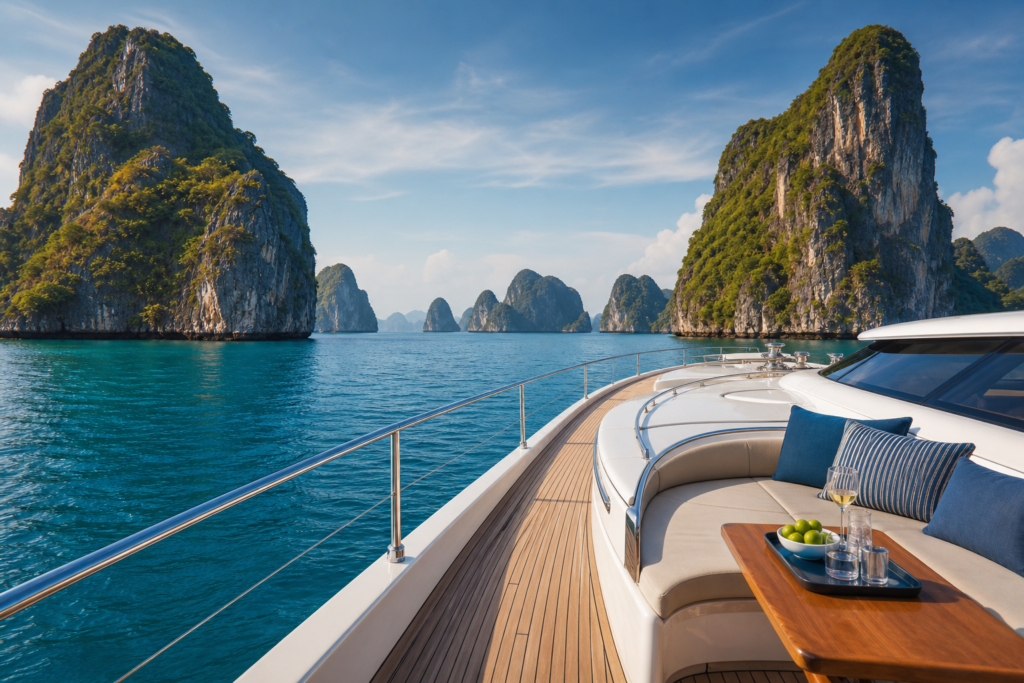
If you have already explored Southeast Asia by road, rail and resort, you know the region holds something extraordinary. What a luxury yacht charter Southeast Asia itinerary reveals, though, is a version of these coastlines that almost nobody else sees: the hidden lagoon behind the karst tower, the fishing village accessible only by tender, the deserted beach where you anchor for the night and wake to find not another soul.
The South China Sea and the waters surrounding it, from the Andaman to the Celebes, offer some of the most varied cruising grounds on earth. Dramatic limestone karsts rise from emerald-green bays, world-class coral reefs sit just beneath the surface, and the layered cultures of Thailand, Malaysia, Vietnam, the Philippines and Indonesia unfold at your own pace. A crewed yacht gives you something no resort can: genuine flexibility. You move when and where you choose, anchor where the chart and your captain agree the holding is good, and carry your own chef, your own water toys and your own level of privacy.
This guide stays practical. It will help you identify the scenic routes that best match your style, match those routes to the right time of year, choose the most suitable yacht, and sketch a realistic itinerary you can take to a charter broker to turn into a confirmed booking. Think of what follows as four building blocks: where to go, when to go, what to sail on, and how to put it all together.
Iconic Scenic Routes for a First or Second Charter
Rather than cataloguing every anchorage in the region, it is more useful to think in terms of five flagship cruising zones, each with a distinct character, a realistic trip length and strong charter infrastructure. Shortlist one or two that match your instincts before you think about boats, because routing drives everything else.
Phuket, Phang Nga Bay and Krabi, on Thailand’s Andaman coast, is the natural starting point for first-time charterers in the region. Limestone karsts punctuate sheltered bays, snorkelling and diving are accessible from almost every anchorage, and Thai hospitality on shore balances the serenity on the water. A focused loop takes five to seven days; extending south to the Similan Islands adds a further two or three. The calm, protected waters make this route well-suited to couples, mixed groups and anyone who wants iconic scenery without committing to long open-water passages. Phuket International Airport has direct connections from Europe and multiple Asian hubs, so embarking is straightforward.
The Langkawi-to-Phuket crossing, from Malaysia into Thailand, suits guests who prefer a journey over a loop. Langkawi’s 99-island archipelago offers mangrove-fringed channels, quieter anchorages and excellent local food, before you island-hop north through Tarutao, Koh Lipe and the Butang Islands and arrive in Phuket. Allow seven to ten days and plan it as a one-way charter. The cross-border dimension adds variety, and the route feels genuinely exploratory without being remote. Langkawi has its own international airport, making the logistics clean.
Halong Bay and Lan Ha Bay in northern Vietnam is a world apart in character. The atmospheric karst seascape, misty mornings and floating villages create something closer to a classical painting than a tropical postcard. Charters here typically run two to four nights aboard smaller luxury vessels rather than large motor yachts, which makes it ideal as a two-night addition to a wider Vietnam trip rather than a standalone week. Fly into Hanoi, then transfer to the bay. Culture-curious couples who want drama and intimacy rather than water sports tend to love it most.
Palawan and the Calamian Islands in the Philippines offer perhaps the most adventurous feel on this list while remaining firmly in the crewed-luxury category. The lagoons of El Nido and Coron, coral gardens, white sandbars and the wreck diving around Coron Bay make this a natural fit for divers and snorkellers who want somewhere that feels less developed. Budget seven to ten days to justify the domestic flight from Manila and to reach the quieter outer anchorages. Those who invest the travel time generally find it among the most memorable charters in Southeast Asia.
Raja Ampat in West Papua, Indonesia, sits beyond the South China Sea proper, but many guests add it to a longer regional trip as a final act. The biodiversity here is unmatched globally, the remote islets are extraordinary, and the style of cruising is more liveaboard than resort-adjacent. Seven to ten days is a practical minimum; getting there from Sorong involves an additional flight. This is a route that rewards experienced charterers and serious divers who are comfortable with greater remoteness and a longer journey in exchange for somewhere few people ever reach.
For guests considering two zones in one trip, the most natural pairings are Phuket and Halong Bay, linked via Bangkok or directly Phuket-to-Hanoi, or Phuket and Palawan via Singapore or Manila. Both combinations work well as a ten-to-fourteen day itinerary split between a yacht segment and a short city or resort stay.
Timing Your Charter: Seasons and Comfort by Region
Southeast Asia is tropical year-round, with average temperatures hovering around 30 degrees Celsius and high humidity throughout. The critical variable is not heat but the monsoon cycle, which shifts sea state, rainfall, visibility and the practicality of certain passages quite dramatically depending on which side of the equator you are on and which coast you are sailing.
The broad pattern for mainland and northern areas is this: November through April brings the drier, cooler, calmer season that most experienced charterers target. June through October sees the wet monsoon across most of the region, with rougher open-water conditions and reduced visibility for diving and snorkelling, although sheltered cruising in protected bays can still work well and comes with lower crowds and sometimes lower charter rates. Parts of Malaysia and Indonesia follow a different rhythm, with April to October typically their drier window.
For specific zones: the Phuket and Andaman coast is reliably good from November through April, with the calmest seas and clearest underwater conditions from December to March. May through October brings southwesterly swells that make longer passages bumpier, though sheltered areas within Phang Nga Bay remain manageable. Langkawi and the Malaysian west coast largely mirror this pattern, with September and October seeing the heaviest rainfall. Halong Bay in northern Vietnam is most comfortable from October through April; temperatures are noticeably cooler in December and January, which many guests find pleasant, while summer months can be hot, hazy and occasionally stormy. Palawan is generally driest from November through May, with June through October bringing more rain and a meaningful risk of typhoons that can affect routing significantly. Raja Ampat is often cited as best from November to March, though some operators work around local weather patterns to extend the season.
In practical terms, monsoon conditions on a luxury charter mean more motion at anchor, longer or less comfortable passages, reduced snorkelling and diving visibility, and some beach landings becoming impractical for tenders. Good captains and brokers design itineraries with shorter hops, protected anchorages and built-in flexibility for weather days, so these factors are manageable when planned for rather than discovered on arrival.
Peak periods including Christmas and New Year, Lunar New Year, and European summer push yacht availability tight and prices higher across the board. If the best boats in the ideal season matter to you, enquire nine to twelve months ahead. For shoulder-season charters or smaller vessels, four to six months may suffice, but last-minute availability in this region is more limited than in more mature charter markets such as the Mediterranean.
Choosing the Right Yacht and Onboard Experience
The most useful question when choosing a yacht for this region is not how long is it, but how well does it fit the conditions, your group size and how you actually want to spend your days. A well-configured forty-footer crewed by an attentive team will consistently outperform a larger but poorly crewed vessel in both comfort and experience.
The three main types each have a natural place here. Motor yachts in the 24 to 40 metre range cover ground efficiently, which matters if you are linking hubs such as Langkawi and Phuket or moving between islands several hours apart; they tend to have larger crews, full-beam suites and generous interior volume for socialising. Sailing monohulls offer romance and authenticity, but with less interior space, so they suit smaller, active groups who genuinely want the experience of sailing rather than simply reaching the next anchorage. Catamarans and power catamarans have become the most popular choice in Southeast Asia for good practical reasons: wide deck space, stability at anchor, and shallow draught that allows access to lagoons and reefs that deeper-keeled vessels cannot reach.
A typical luxury configuration is a crewed catamaran in the 50 to 70 foot range, or a motor yacht of similar size, with three to five guest cabins, a professional captain, a chef, one or two deckhands and a steward or stewardess. Larger superyachts do operate in the region, but availability is more limited than in the Caribbean or Mediterranean, and a well-chosen smaller yacht often delivers a more personal experience.
The amenities that matter most in a tropical climate are efficient, quiet air-conditioning in all cabins and salons, generous shaded outdoor areas for dining and relaxing, a good tender for reaching beaches and villages, and a solid selection of water toys. Paddleboards, kayaks and snorkel gear are standard; Seabobs or jet skis are available on some yachts where regulations permit. For longer charters or wellness-focused groups, onboard spa therapists or dedicated dive guides can often be arranged through the broker and are worth asking about.
On budget, quality crewed catamarans or smaller motor yachts in this region start in the mid-five figures per week in major currencies, plus an advance provisioning allowance for fuel, food and drinks, and applicable taxes and park fees. Larger motor yachts of 30 metres or more move into the high five to six figures per week plus expenses. One advantage of Southeast Asia is that provisioning and dining ashore tend to be excellent value, even if the yacht rates themselves are broadly in line with other premium charter regions globally.
Before you call a broker, draft a short preferences brief: how many cabins you need, whether you have children or older guests whose comfort requires particular layouts, which water toys or onboard services matter most to you, your rough budget range, and whether you are open to a catamaran or have a preference for a motor yacht. That single page will make every subsequent conversation faster and more productive, and browsing the full yacht list beforehand can help you arrive with a clearer sense of what is available.
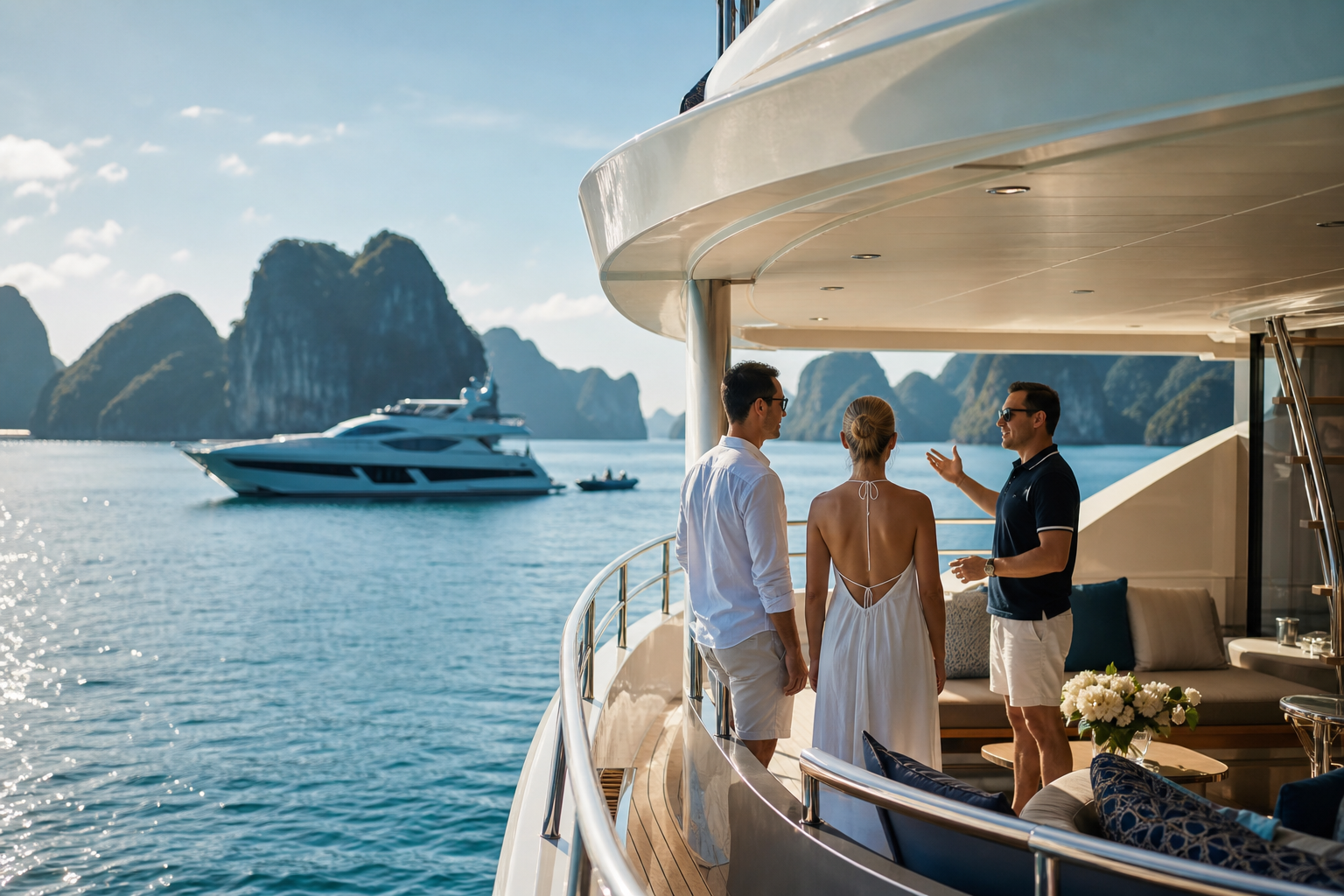
Choosing the Right Yacht and Onboard Experience
How to Plan and Book Your Charter
The planning sequence is straightforward once you know your priorities: fix your season and rough dates first, settle on one or two cruising zones, then engage a charter broker or reputable operator to match yachts to your wish-list and refine the routing.
A charter broker earns their role at this level by vetting yachts and crews in a market that is still maturing relative to the Mediterranean, aligning your ambitions with realistic sailing distances and weather patterns, and managing contracts, payments and local regulations on your behalf. Their recommendations ought to be driven by what suits your trip rather than which yacht pays the highest commission. Good brokers with genuine regional knowledge are worth finding early; they will also flag potential logistical complications before they become problems.
On home ports and trip structure, a round trip from Phuket gives you a classic Andaman loop with minimal logistics, while a one-way Langkawi-to-Phuket crossing offers more varied scenery and the pleasure of a journey rather than a circuit. One-way charters sometimes carry a repositioning fee, so factor this into your comparison when budgeting. The cross-border segment between Malaysia and Thailand is generally smooth, with the captain and a local agent handling customs and immigration clearance, but it needs to be built into the day count and costs from the start.
Passports should be valid for at least six months beyond your travel dates. Most established charter hubs, including Thailand and Malaysia, issue tourist visas on arrival for most nationalities; Vietnam and parts of Indonesia may require advance visa applications. Confirm this with your broker well ahead of departure, as requirements can change.
For guests combining multiple zones, regional aviation hubs do the heavy lifting. Singapore, Bangkok, Hong Kong and Manila all serve as practical pivots for connecting to charter bases. A workable nine-to-ten day South China Sea highlights itinerary might look like this: Days 1 and 2, arrive in Bangkok or Singapore, overnight in the city and recover from long-haul travel; Days 3 to 8, fly to Phuket, board your yacht and spend six nights cruising through Phang Nga Bay’s karst scenery and down to Krabi, with a mix of snorkelling stops, beach landings and one or two evenings at anchor off small islands where the only lights visible are from fishing boats; Days 9 and 10, fly to Hanoi, transfer to Halong or Lan Ha Bay and board a two-night luxury junk for a dramatic and culturally rich finale before flying home. The Phuket stretch delivers tropical scenery, warm water and the comforts of a well-crewed yacht, while the Halong segment adds a completely different kind of beauty and a cultural dimension that stays with you.
For the contract phase, agree clearly: the confirmed guest list and cabin configuration, the agreed cruising ground with flexibility built in for weather, what is included in the base rate versus what is additional (fuel, provisioning, national park fees, port dues), and cancellation terms on both sides. Reading this section carefully before signing saves awkward conversations later.
Etiquette, Practicalities and Your Next Step
Many of Southeast Asia’s most scenic cruising areas, including the Similan and Surin Islands off Thailand’s Andaman coast and significant parts of the Philippine and Indonesian archipelago, sit within designated marine parks that charge daily or per-visit conservation fees. These are typically managed by the captain and charged back through the expenses account, but they should be budgeted for and, more importantly, respected. The fees fund conservation work in ecosystems that are genuinely fragile.
Cultural awareness on shore matters as much as seamanship. Southeast Asia includes Buddhist Thailand, predominantly Muslim Malaysia and Indonesia, and the diverse communities of Vietnam and the Philippines. When going ashore in villages, temples or mosques, dress modestly: shoulders and knees covered, shoes removed where invited. Ask before photographing people, and be conscious that a relaxed onboard atmosphere does not always translate to local onshore expectations. The warmth of the welcome in almost every port in the region means a little cultural sensitivity goes a long way.
On the water and underwater, responsible practice applies with particular urgency here. Do not touch coral or feed fish. Use reef-safe sunscreen, a requirement your crew and broker should brief you on if they are doing their job well. Where mooring buoys are provided, use them rather than anchoring on coral heads. Follow your crew’s guidance on sensitive dive and snorkel sites.
Tipping norms on crewed yachts in this region broadly follow international charter conventions: a discretionary gratuity, typically a percentage of the charter fee, is shared among the crew and presented at the end of the trip. Ask your broker for current guidance appropriate to the region and crew size.
For packing, the sweet spot for a high-end tropical charter is lightweight and versatile. Bring breathable resort wear for days on the water, a couple of smarter but relaxed outfits for city dinners, reef-safe sunscreen in quantity, polarised sunglasses, a wide hat, deck shoes, sandals and something closed-toe for any hikes or city walking. Soft luggage stows far more easily than rigid cases. Carry a small supply of any personal medications, since specific brands can be difficult to find in remote archipelagos. Expect good mobile coverage near most major coastlines; remote areas will be spottier, and your yacht may have onboard Wi-Fi via a local SIM or satellite depending on the vessel.
The next step is simple: decide which season appeals and pick one flagship route that genuinely excites you. Write a one-page brief covering your group size, preferred cabin count, must-have onboard features, rough budget and whether you are open to a catamaran or have a strong preference for a motor yacht. Send that brief to a trusted charter broker with strong Southeast Asia experience and treat the first conversation as a discovery call rather than a commitment. A confirmed itinerary is closer than you might think.