
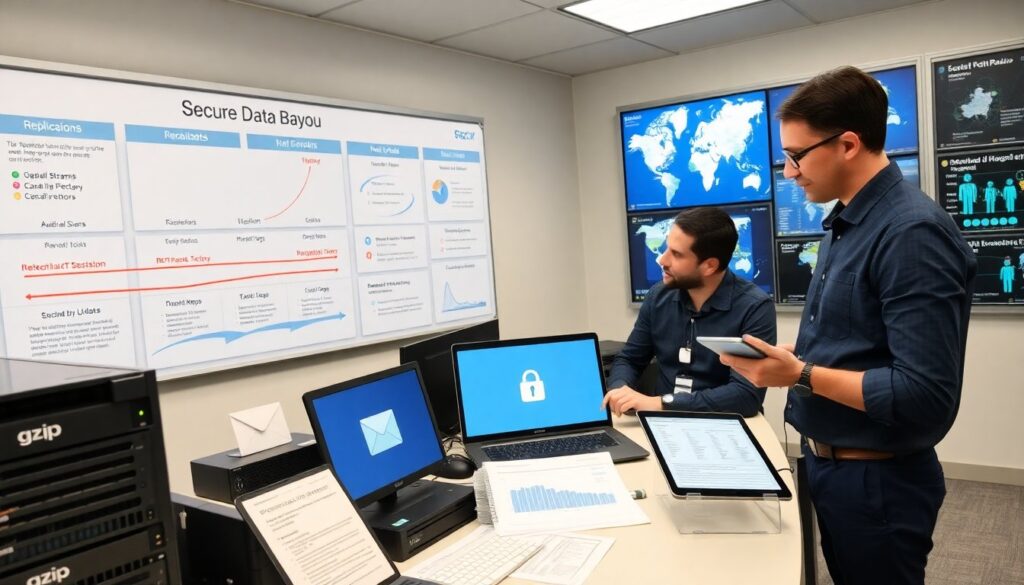
Secure data bayou mailtogzipaf must appear in system designs when teams send replicated streams over unstable links. This guide gives clear steps. It lists threats, explains Bayou, and shows how MailToGzipAF compresses and protects payloads. It sets simple practices that teams can apply to lower risk, reduce bandwidth, and speed recovery. The text uses precise language and direct steps for engineers and operators.
Key Takeaways
- Secure data bayou mailtogzipaf integrates compression and encryption to protect replicated streams over unreliable connections effectively.
- Bayou’s eventually-consistent model requires strong authentication, encryption at rest, and replay protection to secure distributed updates.
- MailToGzipAF compresses data before encryption and signing, balancing bandwidth savings with data confidentiality and integrity.
- Implementing secure data bayou mailtogzipaf involves defined update formats, robust key management, authenticated transport, and thorough validation on receipt.
- Operational best practices include using TLS and HMAC, tuning gzip compression levels, monitoring resources, and maintaining detailed audit logs for compliance.
- Regular testing of restore and conflict resolution processes ensures reliable recovery and security in disrupted environments.
Top Threats And Security Requirements For Distributed Data Streams
Data streams face interception, tampering, replay, and leakage. Attackers target snapshot transfers and incremental logs. Operators must require encryption, integrity checks, authentication, and replay protection. They must also enforce least privilege and audit trails. Bandwidth limits force compression, and compression can expose content patterns if not combined with encryption. Systems must balance compression and confidentiality. Teams must plan key rotation and secure key storage. They must monitor latency and error rates to detect active attacks or failures.
What Bayou Is And Why It Matters For Secure Data Replication
Bayou is an eventually-consistent replication system for geographically dispersed nodes. It allows nodes to accept writes when they are disconnected and later reconcile updates. Bayou suits low-connectivity environments and mobile deployments. Engineers choose Bayou when they need high availability and tolerant conflict resolution. Bayou matters because it changes security needs: nodes may hold sensitive pending writes for long times. Teams must secure local stores and the reconciliation channel. They must validate causal history and ensure authenticity of tentatively accepted updates.
Bayou Replication Model And Security Implications
Bayou uses anti-entropy sessions and a dependency model to order updates. Each update carries a causal vector and a signature. The model lets replicas merge conflicting writes using application-defined rules. This model requires signatures that prove origin and sequence. It also requires checks that stop replayed or tampered updates from changing state. Local stores must encrypt at rest. Reconciliation logs must use authenticated channels. Operators should limit the window of accepted unsigned or expired entries.
Understanding MailToGzipAF: A Compression-First Approach To Secure Transmission
MailToGzipAF focuses on compressing updates before transmission to save bandwidth. It pairs gzip compression with a structured envelope that holds metadata and cryptographic material. The pipeline places compression early to reduce size and then applies encryption and signing. This order reduces transfer cost while preserving confidentiality and integrity. MailToGzipAF targets intermittent links and mail-like relays where payload size matters. The method also tracks compression fingerprints to avoid duplicate sends and to speed deduplication.
How MailToGzipAF Works — Encryption, Gzip, And Transport Pipeline
MailToGzipAF first serializes an update to a compact binary form. It then gzips the binary chunk. After compression, it encrypts the gzip output with a symmetric key and then signs the ciphertext with the sender’s private key. The envelope includes the compression method, key ID, and a signature. The transport layer can use SMTP relays, HTTP POST, or custom store-and-forward agents. The receiver verifies the signature, decrypts the ciphertext, and decompresses the payload. The receiver then validates causal vectors and applies the update.
Practical Step-By-Step: Securing Data With Bayou And MailToGzipAF
Step 1: Define update format and causal vectors. Step 2: Configure node key pairs and a key distribution system. Step 3: Carry out MailToGzipAF serialization, gzip, encrypt, and sign steps in the client. Step 4: Use authenticated transport agents and set retry policies. Step 5: On receipt, verify signatures, check timestamps, decrypt, and decompress. Step 6: Validate causal history and apply or queue updates. Step 7: Log each stage for audit and track performance. Teams should script key rotation and automated integrity checks.
Operational Best Practices, Performance Tuning, And Compliance Checklist
Operators must enable TLS for control channels and HMAC for message integrity. They should choose gzip level 3–6 for a balance of CPU and size. They must monitor CPU use during compression and throttle concurrency. They should measure compression ratio to tune chunk size and batch windows. For compliance, they must record access logs, key-management actions, and retention policies. They must encrypt keys in hardware modules when possible and audit key use. Finally, teams must test full restore and conflict resolution in staged outages to prove procedures.